


An Uncanny Manipulation: Hitchcock’s Tight Grip on the Mind in Vertigo
Zhao Siyuan
Introduction
Released in 1958, Vertigo is a psychological thriller film directed by Alfred Hitchcock. Honored as the legendary ‘Master of Suspense,’ Hitchcock is known for his innovative approaches in visual narration through filming techniques and montage. The film was crafted as a haunting exploration of obsession, control, identity, and hallucination with the profound use of the ‘dolly zoom’ to convey disorientation and delusional effects. Vertigo stars James Stewart as John “Scottie” Ferguson, a retired detective diagnosed with acrophobia (a fear of heights) from psychological trauma, and Kim Novak in a dual role as Madeleine Elster and Judy Barton.
In the film, Scottie is requested by an old friend to investigate his wife, Madeleine, who is suspected to be possessed by the ghost of her ancestor, Charlotta Valdes. Scottie becomes dangerously obsessed with Madeleine throughout the course of his request and is left heartbroken after her ‘suicide.’ However, the ‘Madeleine’ that Scottie trails is a counterfeit played by Judy, a woman who has the identical look as Madeleine and is involved in a planned murder to kill the real Madeleine. Scottie later encounters Judy and starts forcefully reshaping Judy into another ‘Madeleine.’ However, Judy accidentally reveals the truth about the murder to Scottie, who is enraged and drags her back to the crime scene, where she falls from the bell tower.
Through Hitchcock’s strategic employment of the uncanny, the film Vertigo is molded into an affective medium of mirroring the protagonist’s obsession while deceiving the audience into resonating with the male protagonist, hence blurring the line between bystander and accomplice. In this essay, I will be analyzing Hitchcock’s use of cinematographic techniques, doubles, and dehumanization of characters.
Literature Review
Although now recognized as one of the most acclaimed films in cinema history, Vertigo received polarizing remarks from both professionals in the industry and the public during the period of its release. The film had a hard time reaching breakeven in the box offices due to disappointments from fans and criticisms from authorities in the industry such as Orson Welles and Anne Bilson, which mainly targeted Hitchcock’s rationalization of the “sexual creepiness” and his take on concealing the nature of “male-gaze” (Batters, 2019). The murder plot of the film was also remarked as simple and crude, and even preposterous by some; however, Hitchcock encouraged the audiences’ projection into the film from a personal level by dragging them into the protagonist’s perspective, hence participating personally in the film (Ravetto-Biagioli & Beugnet, 2019). Many scholars believed the intrinsic theme of this film is obsession, expressed by trespassing into the audiences’ minds, thus urging them into riding the fence between illusion and reality, as Holland (2025) states, “Is probability that important? Is realism? Verisimilitude? What matters is perceiving a work of art as a work of art, and, psychologically, realism only matters if you make it matter” (para. 18). Hitchcock not only achieves such emotional effect by his effective play on montage, but also through his successful utilization of “the uncanny,” which is a cognitive discordant that occurs when something is simultaneously creating familiarity and oddity (Clegg, 2018).
The concept of “the uncanny” was first stated by Sigmund Freud in 1919, which draws attention to the discomfort that arises from the familiar made strange, such as lifelike robots or dolls (Freud, 2003). Freud’s explanation towards such discomfort correlates to a cognitive disorientation caused by the blurred boundaries between animation and inanimation. This concept was investigated and revised by Masahiro Mori, who then officially proposed it as the Uncanny Valley Theory in 1970. Mori posits that as artificial entities become more identical to humans, empathy is continuously elicited until a breaking point where the near-perfect realism of the entities triggers disturbance or even revulsion due to their minor inhuman characteristics (Mori, 2012). This is illustrated by the “valley,” which refers to the dip on the graph of emotional response of humans when they encounter a lifelike artificial entity (see Appendix 1). Integrating both Freud’s and Mori’s theories, the uncanny valley appears when the human replicas’ human-identical traits trigger psychic alarms of mortality, deception or existential ambiguity and crisis, which would in turn evoke cognitive dissonance (Freud, 2003). Such a disoriented approach has vividly depicted Hitchcock’s distinctive gothic aesthetics and has allowed him to tighten his grip from Vertigo’s visuals to the audience’s minds.
Surrealistic Expression: Hitchcock’s Manipulative Cinematography
Hitchcock’s distinct shooting and editing techniques are a major component in immersing the audience and evoking the uncanny sensation. By applying disorienting shots, deliberate repetition, and strategic pacing of shots, the film captures the protagonist Scottie Ferguson’s psychological instability and implicates the audience into a shared experience with Scottie’s obsessiveness. Out of all shooting techniques, the “dolly zoom”, also known as the “vertigo shot”, is the most iconic and widely known effect, which is used multiple times throughout the film. This effect is first used when Scottie looks down the rooftop while dangling on the edge (0:03:38), with the camera zooming in and tracking out simultaneously to create an uneasy spatial warp, which visually reproduces a virtual acrophobia sensation and forcefully places the audience into Scottie’s disoriented perspective, as the first manifestation of the uncanny in the film. The same effect is reused later in the film (1:15:57, 1:16:08, 2:02:35, 2:02:53), all under similar circumstances of acrophobia and anxiety of the protagonist, which not only underscore the linkage between this effect and acrophobia together, but also subtly embed the audience’s impersonation deeper as the protagonist (Scottie).
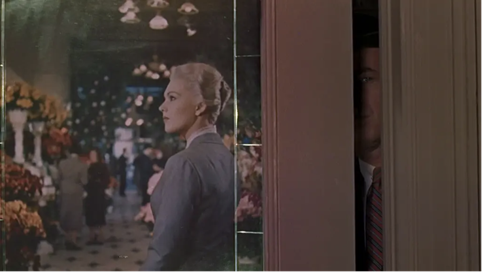
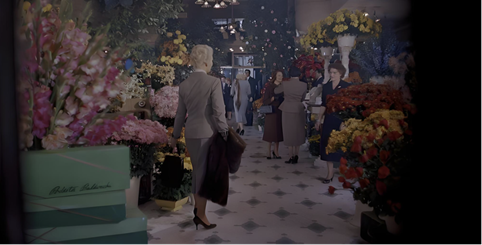
Despite the “dolly zoom,” Hitchcock’s take on framing and composition also contribute to building up an unpleasant uncanny effect. In the flower shop scene, the mise-en-scene was set up in warm, saturated colours supplemented by hazy lighting that slightly obscures Madeleine’s facial features and her mysterious charm, creating a dream-like, ethereal allure, consolidating her unreality. When Scottie peeks through the door crack, Madeleine’s profile is reflected and framed by the mirror behind the door, creating a compositional split screen effect (00:20:38). This composition implies Madeleine’s unreality using mirror reflections and fragments the shot into two using chiaroscuro, which creates a surreal sense of detachment, as if the two characters are not in the same space or even dimension. This manipulation of light and dark is successful in striking the audience with pleasure but also guilt and anxiety from the moral condemnations of performing voyeuristic actions, which again ties the audience down as accomplices of Scottie.
Hitchcock’s application of editing techniques also creates a profound impact in the construction of a disturbing uncanny sensation in the film. In the nightmare scenery (1:23:40), the mass employment of jump cuts – synchronizing with the fortes in the background music – composes an integration of diegetic and non-diegetic elements, which fosters an extremely inharmonious harmony that is isochronous but always conflicting with each other, creating an uncanny sensation. The constant change of vibrant coloured filters and animated spirals generates an unnatural and surreal imagery, plunging the audience into Scottie’s shattered psyche. The jarring cut from a close-up of Scottie’s horrified expression – accompanied with the loud brass and percussion instrumental (1:24:39) – to an almost silent day time shot of the asylum – accompanied by faint diegetic audio (1:24:44) – jolts the audience by replicating an abrupt shift from hallucination to reality. By synchronizing the audience with Scottie’s perspective both visually and auditorily, Hitchcock makes sure the audiences are as trapped in the uncanny as Scottie is.
Cognitive Dissonance: The Doppelgängers
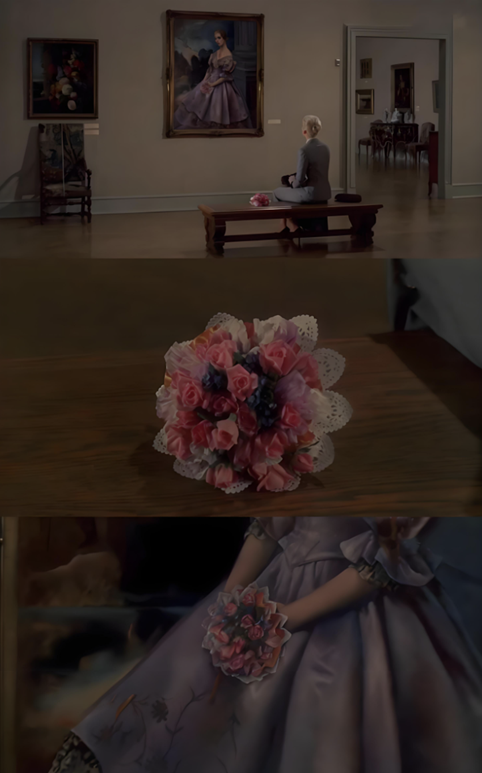
The concept of doubling is significant enough to be rendered as a major motif in Vertigo, and is exploited by Hitchcock in reinforcing the uncanny through repetition and segmenting identity. Madeleine and Judy are evident doubles that are apparent to the audience, but this concept is further extended by Hitchcock both visually and narratively, as audiences go deeper into the plot. Going in chronological order, Judy’s ‘Madeleine’ and Madeleine’s ancestor, Charlotta Valdes, is the first double that is revealed. In the gallery scene, Scottie trails Madeleine into an art gallery and peeks from a voyeuristic position; the camera moves from a close-up of Madelein’s bouquet to a close-up of the bouquet that Charlotta is holding in the painting; both of these close-ups are identical with each other (00:25:45). The shot is then cut to a zoom into the spiral in Madeleine’s hair and shifted to an identical zoom into an identical spiral in Charlotta’s hair (00:25:53). This sequencing of shots constructs a bizarre echo between three-dimensional reality and two-dimensional paintings, summoning an odd, eerie sense straight from the guts, as if forcefully rendering a human being as something lifeless and compelling an object as a lifeform.
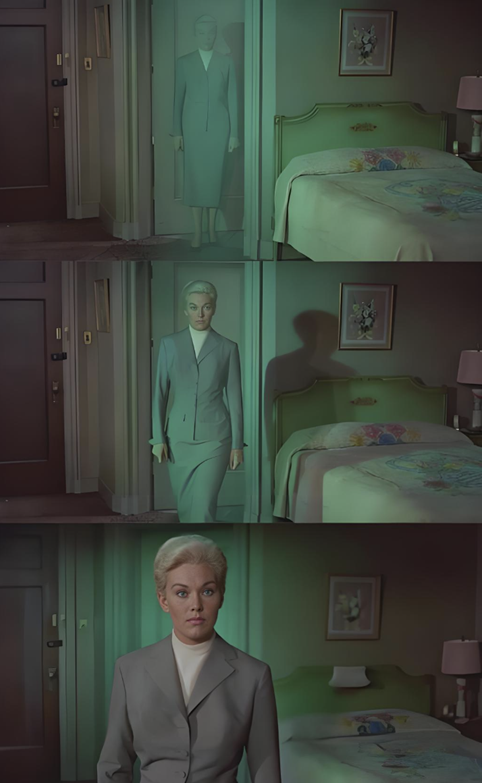
Moving onto Madeleine and Judy, the use of mirrors and reflections takes Hitchcock’s play on doubles to a further extent. Madeleine is reflected through a mirror when Scottie observes Madeleine in the flower shop, which exemplifies her unreality (00:20:38). Judy is also reflected in a mirror later on in the film, as she is just compelled to dye her hair blonde (01:53:33). Judy is unwillingly dressing herself as her non-existent past self who has died, which depicts the horror of being forced into another identity. Hitchcock’s doppelgänger trick further escalates in the final scene, when Judy – dressed as Madeleine – is forced to redo her hair into Madeleine’s spiral (01:54:56). A ghostly superimposition of Madeleine’s pale figure over Judy showcases an uncanny glimpse of the past and future, shackled together in realistic and fabricated manners.
The doubling of locations is perhaps the most significant pairing of all in Vertigo. The location where the real Madeleine is murdered and where the fake Madeleine commits suicide (01:15:40) is revisited after Scottie has discovered the truth behind Madeleine’s death (02:01:29). Hitchcock restores most of the shots and presents both scenes in a similar, almost parallel tempo and pace, trailing behind very much identical cyclical structures and in turn trapping both Scottie and the audience in a never-ending loop. The inescapable feeling from the loop amplifies the uncanny sensation of everything being just a distorted recurrence. This is the audience’s last push into despair and the final signifier that testifies the audience’s complete fusion with the protagonist.
Dehumanization and Objectification: A Deviation from Humanity
In Vertigo, uncanny sensations are expressed through the objectification of human beings through fragmentation and fetishistic perspectives. The heroine, Madeleine/ Judy, is not presented as an autonomous being but simply portrayed as imaginary projections of male desire. Madeleine’s identity is built as a specter, constructed from a spine of lies and the flesh of fraudulence by Gavin Elster to deceive Scottie. Her made-up fascination over Charlotta Valdes molds her into a vessel to revive the past, which drags her towards a ghostly figure instead of a human (00:25:42). Scottie’s rage in the tower staircase uncovers the intrinsic nature of his obsession to be “a desire to possess” instead of “love” when he says, “He made you over just like I made you over, only better!” (02:04:06). Scottie is unsatisfied with the fact that he is not the first man to “own” Madeleine, and him being tricked by that man, treating Madeleine as a beautiful vase of mystery rather than a person.
Judy’s makeover causes even more uncanny disturbance, as her identity is shattered into pieces then shoved into the identity of a dead person by Scottie through attire, chemical hair dye, and compulsion (01:46:24-01:53:55). Judy’s reappearance after restoring Madeleine’s hairstyle is a grotesque rebirth as a revisualized phony fantasy, while Madeleine’s pale superimposition on her reinforces her current identity as a manmade artefact or installation, demonstrating her deviation from humanity (01:54:56). Taking both identities (Madeleine and Judy) into consideration, neither one of them is allowed to exist independently as a human being – Madeleine is a figure for show, and Judy is her replacement, with both fragmented by the fetishistic male-gaze. Their deviations through spectral possession and forceful transformation leave the audience with the ultimate uncanny, showcasing the fragility of identities and questioning the relation between illusion and reality.
Conclusion
To conclude, Alfred Hitchcock’s Vertigo is a meticulously constructed descent into deep obsession, where the fine line between illusion and reality is obscured beyond distinction. Hitchcock’s manipulative cinematography is capable of significantly immersing the audience in Scottie’s disorientation, and of sharing his vertigo, his paranoia, and his obsessiveness with the audience. The “dolly zooms,” the compositional framing, and the nightmare all aim to trap the audiences in the same uncanny nightmare as Scottie. The film’s extensive use of doubling (of characters, objects, locations, and narratives) reinforces the horrific sensation of repetition and the inescapable loop of reality. Madeleine and Judy are specters, reflections, hallucinations and artefacts, or anything but women, with malleable identities under the mallet of male desire. The subtleties of Vertigo compel the audience to resonate with the uncanny. Hitchcock’s remarkable style of narration forces the audience to question their own perceptions and reality, subconsciously holding themselves as an accomplice of the protagonist and eventually becoming a part of the show.
Batters, P. (2019, February 26). Alfred Hitchcock’s vertigo (1958): The art of obsession. Silver Screen Classics.
Clegg, K. (2018, March 9). A brief tour of the uncanny valley. Medium.
Freud, S. (2003). The uncanny (D. McLintock, Trans.). Penguin. (Original work published 1919)
Holland, N. (n.d.). Norman Holland on Alfred Hitchcock’s vertigo. A Sharper Focus.
Mori, M. (2012). The uncanny valley (K. F. MacDorman & N. Kageki, Trans.). IEEE Robotics & Automation Magazine, 19(2), 98–100.
Ravetto-Biagioli, K., & Beugnet, M. (2019). Vertiginous Hauntings: The Ghosts of Vertigo. Film-Philosophy, 23(3), 227–246.
Appendix 1:
The ‘Valley’ of Uncanny Valley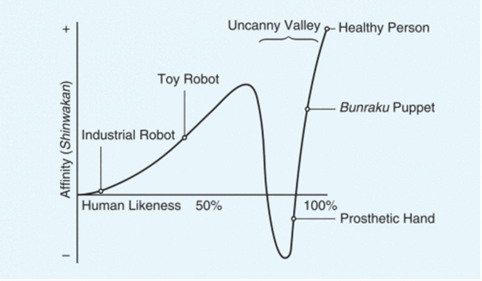
Appendix 2:
Madeleine’s pale superimposition
Appendix 3:
Split screens of voyeurism in the flower shop.
Appendix 4:
Match Cut, blurring of the portrait and reality
Appendix 5:
Frame in frame: Voyeurism in the flower shop
Writer's Bio:

My name is Zhao Si Yuan (Sophia), enrolled in the Language and Professional Communication (Digital Media) program of PolyU SPEED. I was on the Dean's List in 2023 and 2024, and was honored to serve as the MC of the Mascot Naming Contest and the Merit Certificate Awarding Ceremony for the e-learning Putonghua courses.
Film Art, Language and Culture (LCS4784) deepened my understanding of film making and film history, and it developed my appreciation for the cinema both as an art form and a vessel of cultural text. In this course, studying shooting and editing techniques, from Mise-en-scène to Montage, has enhanced my analytical perspective of cinematography, while the reenactment project provided us with hands-on filming and editing opportunities, hence fostering a better understanding of the creation of films.
In this essay, I focused on investigating Hitchcock’s manipulation of the audience’s minds through the creation of cognitive distortion in their minds, with reference to Sigmund Freud’s idea of the uncanny (1919). Hitchcock has achieved this through a variety of approaches. I chose to focus on cinematography, use of Doppelgängers, and the dehumanization and objectification of the heroine. As a former art school student, I have always been interested in the art of film and cinematography, and I wish to further investigate film art in future.